Structured Interview Notes and Scorecards for Startups
How to write structured interview notes and scorecards: rate specific areas, force a recommendation, back every rating with an example, log each round.
On this page
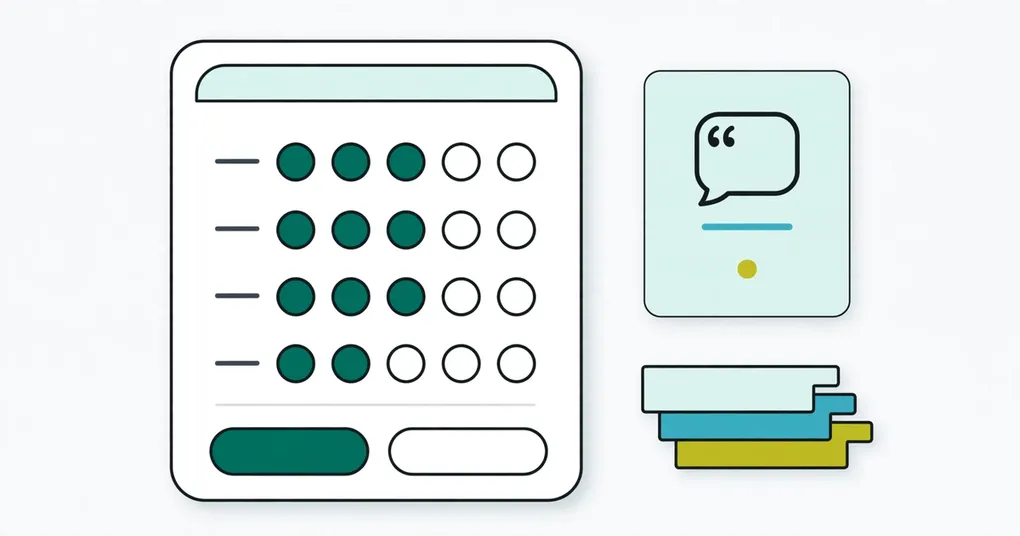
Structured interview notes are feedback written against the same few criteria, with a rating, a clear recommendation and one concrete example behind each score. They fix the usual problem with startup interviews: notes like “seemed nice” or “maybe?” that nobody can compare or remember a week later. This guide shows a scorecard you can copy into any tool, and how the interview rounds in TalentsGrid map onto it.
Key takeaways
- Decide before the interview what you will evaluate. Three to five areas is enough.
- Rate each area on a fixed scale and write one example for every rating.
- Make every interviewer give a recommendation: strong yes, yes, maybe or no.
- Log each round on its own, so you can see who thought what and when.
Why do unstructured interview notes fail?
Unstructured notes fail because they leave room for bias and cannot be compared. Four things go wrong most often:
- Recency bias. The last ten minutes color everything. A good closing conversation becomes “strong candidate”. A stumble on the last question becomes “not sure”.
- No common scale. One person writes “great communication”, another writes “technical skills solid”. You cannot rank candidates on that.
- The loudest voice wins. Without written feedback, the decision goes to whoever speaks first in the debrief or emails their opinion first.
- Memory fades. “Good energy, knows React” means little a week later. Which React questions did you ask? What was the good energy?
How do you structure interview feedback?
Structure feedback by splitting it into specific areas, rating each one, and tying each rating to evidence. Here is a scorecard that works for most roles.
| Part | What to write | Example |
|---|---|---|
| Areas | 3 to 5 skills chosen before the interview | Technical depth, problem solving, communication |
| Rating | 1 to 5 per area, with the scale defined | 3 = meets the bar for this role |
| Evidence | One concrete example per rating | ”Explained the payment architecture clearly, rambled on failure cases” |
| Recommendation | One of four options, no hedging | Strong yes / Yes / Maybe / No |
| Deadline | Same day, or within 24 hours | Written before the debrief, not during it |
Define what each number means before you start. A “3” should mean the same thing to every interviewer. Otherwise one person rates everyone a 3 or 4 and another swings between 1 and 5.
Pick the areas first
Write down the three things you want to learn from this interview before it begins. For a developer role that might be technical depth, how they approach an unfamiliar problem, and how clearly they explain their own work. Judge what you said you would judge, not whatever came up in conversation.
Require an example for every rating
Compare two versions of the same note.
Weak: “Communication 4/5.”
Useful: “Communication 4/5. Explained the architecture of their last project clearly. Got rambly when I asked about failure cases.”
The second one still makes sense three weeks later, when you are trying to remember why this was a 4 and not a 5.
Force a recommendation
Ask every interviewer to pick one of four options:
- Strong yes: we should hire this person.
- Yes: I would be happy to work with them.
- Maybe: I have concerns but could be convinced.
- No: do not hire.
Leave out “leaning yes” and “probably”. If an interviewer cannot commit, you either need another round or the interview did not cover enough.
Be careful with “culture fit”
“Culture fit” is the area where notes get vaguest. Replace it with something observable, such as “gave credit to teammates when describing past work” or “asked for feedback during the exercise”. If you cannot name the behavior, leave the area out.
Why log each interview round separately?
Logging rounds separately lets you see how opinion changed from the phone screen to the final conversation, and which interviewer saw what. A single blob of “interview feedback” hides that. A typical sequence is a phone screen, a technical interview, a team conversation and a final round. Each gets its own notes, rating and recommendation.
How does TalentsGrid handle interview notes?
TalentsGrid is an AI hiring copilot for freelance recruiters and small teams: it scores each CV against your job with quotes as evidence, turns gaps into interview questions, and keeps your candidate data yours. For the interview stage it has three pieces. Here is what each does today.
- Interview rounds on each application. You add a round with a type (technical, HR, behavioral, final, phone screen or other), a date, the interviewers’ names, a rating from 1 to 5, a recommendation and free-text feedback. Rounds stay on the candidate’s application, so you can read them in order.
- Scheduling. The Interviews page lists scheduled interviews with the candidate, type, time, location or video link, interviewer and status (scheduled, completed, cancelled or no-show). You can also ask the chat assistant to schedule one, and it waits for you to confirm the date and time.
- Interview kits. When a CV does not prove a skill, the gap becomes an interview question with a guide to what a weak, fair and strong answer sounds like. The questions are generated for you and are not editable. See interview kits.
The round form has one overall rating from 1 to 5, not a rating per area. If you want per-area scores, write them in the feedback field, one line per area with its example. The recommendation uses the four options above, and you can also leave it empty.
AI recommends in this flow and you decide. Nothing moves a candidate forward or rejects them without your action. A kit tells you what to ask. It does not grade the candidate for you.
You can run the same method in a spreadsheet or a shared doc. What matters is that every interviewer uses the same structure. The ratings are a way to think more clearly and to calibrate over time. They are not a measurement. Pair this with a clear hiring pipeline so each stage has an owner and an exit rule.
What objections come up, and how do you answer them?
“This is too bureaucratic.” Ten minutes of structured notes costs less than a long debate about who feels good about a candidate when nobody remembers specifics.
“We are too small for process.” Small teams have the least attention to spare. A light scorecard is how you protect it.
“Ratings feel arbitrary.” They are, a little. But a rating on a defined scale can be calibrated over time. An unquantified impression cannot.
“What if interviewers disagree?” Good. Disagreement visible in written feedback is a signal to investigate. Disagreement hidden in vague notes is how weak hires slip through.
What should you try first?
Before your next interview, write down the three things you want to evaluate. Afterward, rate each one and add an example. Then pick a recommendation. That alone puts you ahead of most teams. If you want rounds, scheduling and interview kits in one place, start for free. The free plan needs no credit card, and details are on the pricing page.
FAQ
What should structured interview notes include?
Include the interview type and date, three to five areas chosen beforehand, a 1 to 5 rating for each, one concrete example behind every rating, and a final recommendation of strong yes, yes, maybe or no. Add anything unresolved that the next interviewer should probe.
What is a good rating scale for interviews?
A 1 to 5 scale works well if you define each number first. For example, 1 is a clear gap, 3 meets the bar for the role, and 5 is well above it. The definitions matter more than the scale, because they keep different interviewers consistent.
How soon should interviewers submit feedback?
Within 24 hours, and before the team debrief. Writing before you hear other opinions keeps each interviewer’s view independent. Memory also fades fast, so the same-day notes are the most accurate.
Can TalentsGrid score a candidate for me during the interview?
No. TalentsGrid scores CVs against a job and turns gaps into interview questions with weak, fair and strong answer guides. The interview rating, recommendation and hiring decision are entered by you. AI does not accept or reject candidates.